Battery Pack Design
This project was done for a Chinese company seeking to advance their battery pack portfolio.
With a successful line of products in that sector, the client perceived their designs as outdated and falling behind.
Seeking to improve the situation with outside support, we were brought on board.
Within 6 months we achieved the following:
- Understanding the client’s manufacturing technologies and capapbilities
- Understanding current design and construction methods
- Optimization of designs for quality, reliability and efficiency
- Develop the first generation of high-performance battery packs
- Significantly support R&D of core technologies
- Pave the way for increased automation in production
- Supply further development tracks
To the latest of our knowledge, these battery packs are now available for purchase online.
After gaining a thorough understanding of our client’s philosophy, market and aims we worked together on a set of requirements for the new product type.
- High energy density, low weight segment
- Safety was considered a USP
- Market entry B2C, with B2B derivatives to build on the design
- Internal design to lean on upgraded existing philosophy
- Case design to be rethought from scratch
- Rely on existing production means for manufacturing
- Improve manufacturing capabilities were necessary and sensible
This term is crucial for the application in question.
Thermal runaway can occur initially in single battery cells and spread.
We cooperated on implementing a combined approach at:
- Reducing thermal runaway chances of occurring
- Managing the effects of TR occurring
- Ensurig a single-cell TR wouldn’t cause a chain reaction.
Almost every component of our solution was designed with this specifically in mind and presents a reoccuring consideration.
Tight cell spacing required for high efficiency and low footprint directly counteracts thermal management and thus product safety.
In order to better manage longevity and safety, our client decided to combine his application of phase change material (PCM) with potting.
Potting relies on an expanding foam, challenged by the tight cell spacing and layer of thermally conductive phase change material.
After joining the project we were able to solve the technological challenges still in place, aid tooling design and help our procure a suitable application machine for serial production.
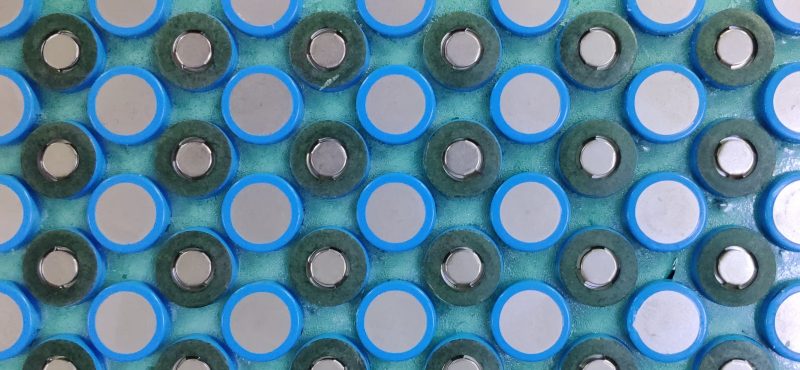
As part of the original design, the cell holders (white) useed to be placed at the ends of the battery cells.
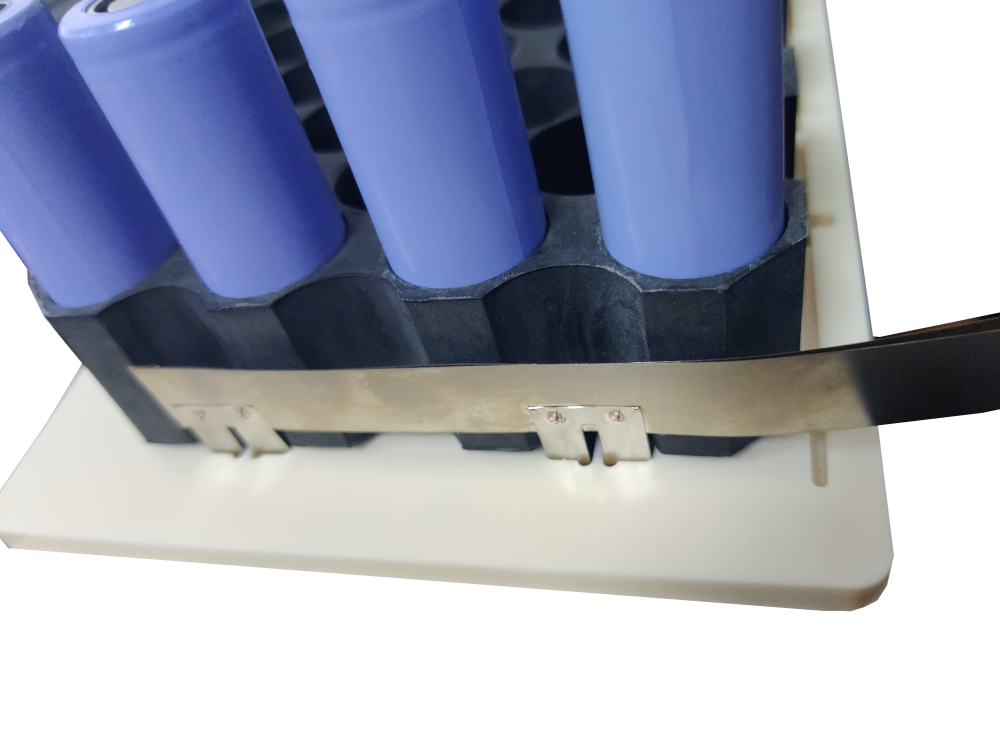
Stamped nickel strips using a carefully designed geometry were placed on the outside of these cell holders and welded.
Afterwards, specific insulation had to be applied to shield the exposed metal strips.
We significantly upgraded the entire cell holder for safety, economy and automation.
Initial production required machining both sides, adding significant manual intervention and reduction in efficiency.
We redesigned the holder for single-side machining, allowing for overnight machining and almost complete elimination of human intervention.
Single side machining allowed the nickel strips to be placed inside the cell holders.
This meant the need for insulation was much reduced and overall product safety increased compared to traditional means of insulation.
A resulting reduction in insulation material brought with it economic and environmental benefits.
Production could also be streamlined and was more suitable for production, especially once combined with potting.
Crucial details, such as specific bending geometries to allow for expansion, contraction and flexing during loads were also incorporated increasing longevity and safety.
Naturally we provided all required tooling for mass production and automation.
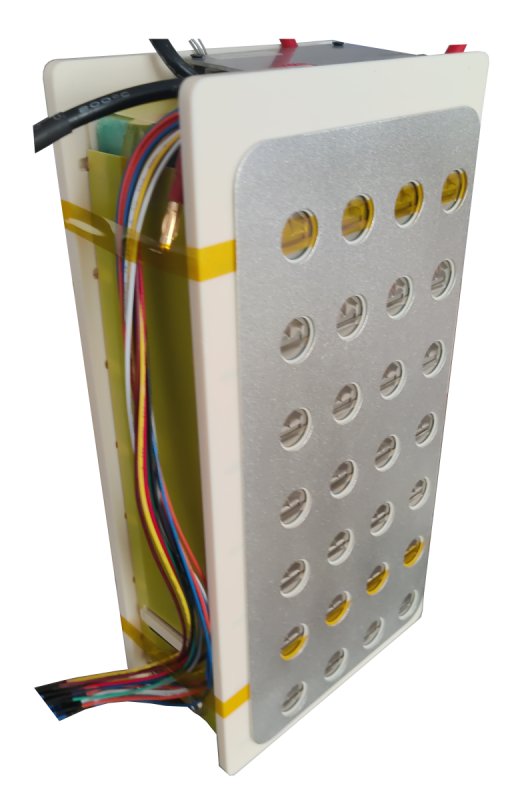
Old case designs relied solely on plastics – either by buying proprietary standard cases or machining plastic boards.
Our customer considered this an issue and unsuitable for the future.
Aluminium extrusions as a solution had been considered but no breakthrough achieved.
Together, we decided to create an entirely new extrusion from scratch.
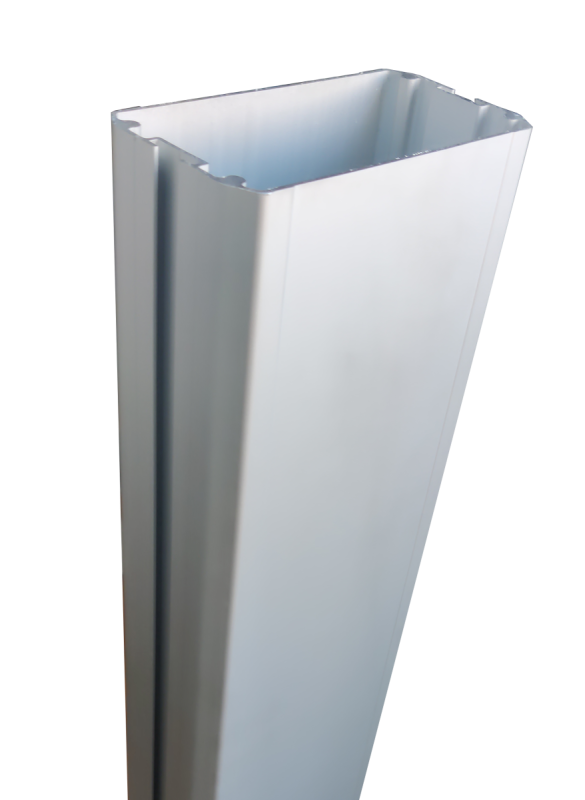
The underlying principle relied on a full aluminium body that would double as a heat sink.
We designed the shape entirely from scratch, including various elements:
- Strenghtened edges for added rigidity and quality aesthetics
- Chamfered edges for easy guidance, rigidity and visual appeal
- Multipurpose recessed side rails
- Split channels for seperated wiring
The wiring channels are another new feature linked to a rethinking of the way the electrical connections were done. By splitting the wiring into seperate channels we were able to further reduce the risk of shorts and improve cooling.
Designated spots for cover plate drilling were executed as solid upon customer request as to improve protection against water ingress.
Initially, significant changes to the interface had not been planned.
We provided a convincing set of improvements that were taken over for the entire product range.
Front plates
Designed from the ground up to provide an upgrade to existing designs and be applicable to the new product, we optimized the location of charging port and connector in order to improve internal wiring, clean up the design and provide greater utility.
For the new battery packl the plates are designed to slot in so as to add further water ingress protection.
Charge LED
Existing designs used individual, drilled recesses.
These provided an uneven geometry and were hard to finish.
Using existing PCBs made recesses necessary for the moment, so we reduced the execution to one machined line.
This slightly improved economy in manufacturing and finish, more importantly however the looks were much improved.
The new design enabled external sealing via a perspex sheet if desired.
Charging port
Previous designs had the charging port slightly stick out of the plate, however we found the access latch rather uncomfortable to open in this arrangement.
Thus we relocated and added a chamfered recess to improve user experience.
Charging cable
The charging cable had been a known issue.
We supported the ongoing development towards a variety of different standard connectors and cable adapters.
During these, we initiated an immediate design upgrade to existing products: Previously, connectors had been angled away from the pack and bolted on via a sort of baffle, giving the B2C products a more industrial look and causing the cable to always stick out and be a nuisance.
We turned the cable around 180 degrees, recessed it into the front plate and provided a friction lock for the connector.
During recess design, we were able to eliminate the baffle, reducing parts variety and sealing surfaces.
Styling
Branding was becoming more of a focus for our client.
As a means to customize the user experience, we proposed offering various color schemes for both case and end caps that would appeal to consumers yet be cost-efficient to manage.
Also, we showcased various means to more prominently display their logo on the battery pack: CNC machined to the front plate, laser engraved to the case side or via plastic inserts into the side rails.
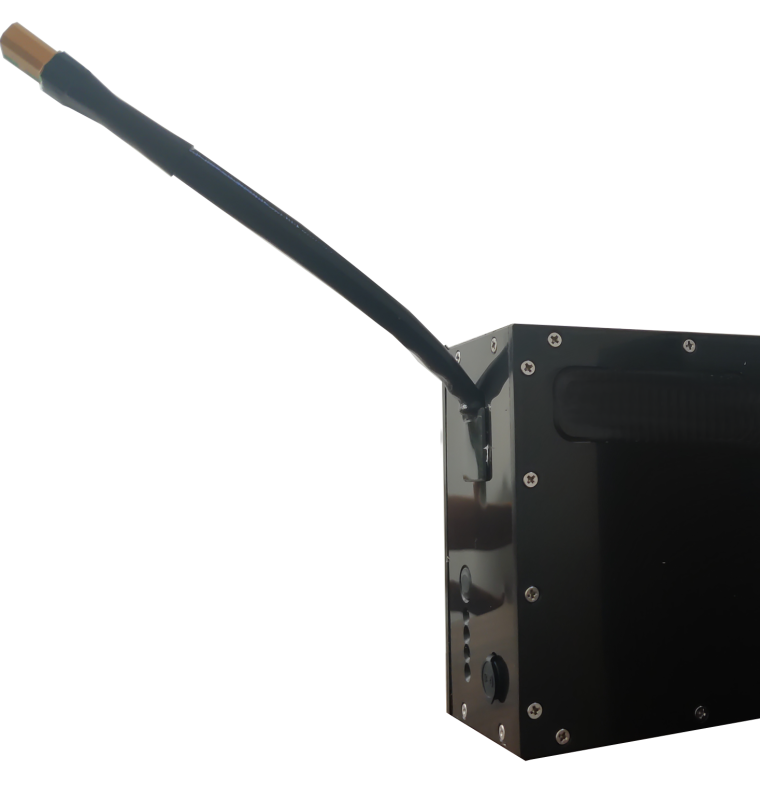
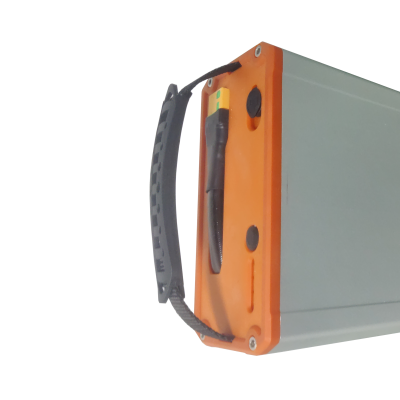
Previous proprietary battery packs had either no mounting brackets or required the purchase of complex, bulky, custom-sewn bags.
These battery packs were going to be somewhat heavier and thus more cumbersome to handle as well as creating security considerations when carrying over bumps.
As a result we decided to implement a pair of external rails that offerd multiple functionality:
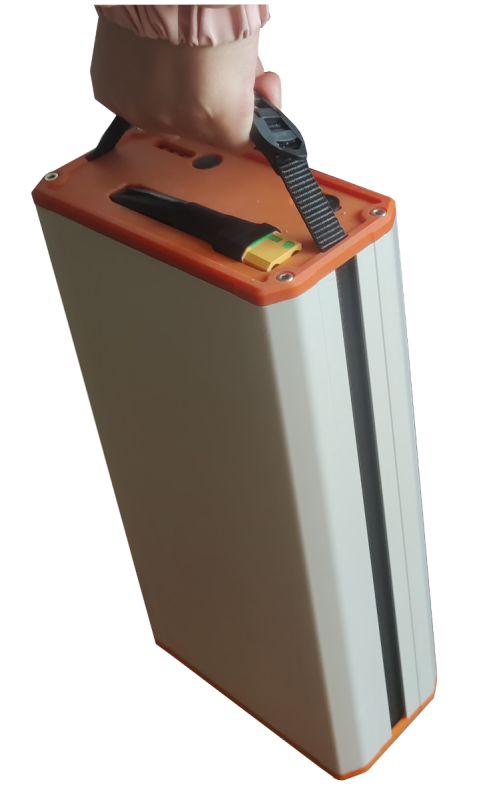
Carry handle (pictured)
Going around the entire circumference of the pack including the bottom cover, the internals’ weight would not rest on the bottom plate but be transferred around the entire case instead.
Docking station
Minor changes to the bottom plate allow the rails to be used as secure points for mounting into a special receptacle/docking station if desired.
Side handles
By using the rails as T-slots, carry handles can be mounted on either or both sides of the case.
Branding
By including small strips of plastic featuring the company’s logo, effective branding can be achieved