

SUBSIDIARY COMPANY
Short overview
The following points go into a bit of detail and are meant as examples and can be expanded by topic relevance.
All are taken from one particularly complete business case undertaken from 2020-2023.
In order to provide as complete a showcase as possible, we focus on an investor with a particularly complex set of requirements and during an especially challenging time.
The investor in question is a small business from rural eastern Germany, a region famous for its relative isolation, which saw itself pressed to open a fully independent subsidiary in the People’s Republic of China.
With the business scope – diustribution, no engineering, no IPs, little processing – being outside our field we are able to present a more grounded, fundamental proof of concept.
- Corrections of prior errors
- Process transfer
- Staff training
- Technical support of HQ, vendors and customers
- Assurance of product quality and cost
- Establishment of warehouse to serve existing customers and vendors
- Analysis and mapping of German HQ’s business model, industry, processes and structure
- Formulation of multi-stage business plan and continuation strategy
- Correction of missteps, improvement of corporate image, widespread establishment in the industry
- Definition and implementation of milestones and long-term business strategy
- Full legal representation
- Implementation of company group policies and operations
- Continuity management
- Continunous chance-risk assessment and measures
- Quality implementation and management
- Buildup and development of corporate competence
- Covid-19 pandemic crisis management, including related restrictions and lockdowns
- Establishment of required operational networks and resources
- Complete HR responsibility
- Customer relationship setup in automotive sector
- Strategic vendor partnership setup
- Technical, production and QC suport of vendors and customers
- Financial and accounting planning and supervision
- Complete IT planning, adaptation and implementation
- Business model review, analysis, updates and strategic policies
- Frequent reporting, consulting as well as best-practice advice
- Preparation of turnkey company
Detailed Summary
Prior to task acceptance, we analyzed the variables involved:
- Investing company, portfolio, basics, requirements
- Investing company’s cultural and political situation
- Site conditions and business environmentL
- Government regulations
- Visa requirements
- Funding requirements
- Local support agents
- Transitioning of corporate and personal assets (insurance, property, etc)
Upon the investor’s desire to duplicate as much of the existing corporate structure as possible, we accumulated a detailed map and understanding of the parent business.
Thus, Sebastian spent three months analyzing the parent company from within including comprehensive chance and risk analysis, stakeholders, structures and processes.
This included the creation of written process flows, operrative procedures and key roles.
- Generational shift in ownership created factors to watch out for – direction, commitment, management bloat and expertise
- Various foundational decisions had been made that would present serious challenges especially in the sensitive early stages
- Essential channels and information were made unavailable due to internal politics, critical questions often left unanswered
- IT was preparing to roll out a large systems upgrade, enabling process analysis and training only on the old system
After careful study and further clarification, we were able to define an updated work package.
- Critical, mandatory processes could only be implemented upon complete reconsideration of the local IT infrastructure
- Intensivation of vendor cooperation would be required
- Growth targets would require adjusted strategies in leadership, investment and positioning
- More careful recruiting and leadership of local teams had to be undertaken
- Local expectations needed to be considered
- Sensitivity to locale-specific laws, rules and regulation had to be created
- Chinese customers desired local contacts
Preemptively factoring this in, it was imperative to prepare a far more extensive action plan than what had been imagined.
We prepared the necessary interfaces, contacts and solutions to mitigate isues when and where they were predicted to appear so as to mitigate or entirely negate their effects..
This provided a foundation for transferring the core business and identity to the new location.
As a business case and reason for the endeavor, the supply chain between a guaranteed set of vendors and customers had to be established.
Based on these numbers, the investor had decided on the initial structure he desired.
We worked together with the decision makers to make sure all factors had been well considered.
After data review, we proposed a list of significant changes.
Factors such as
- Changing market situation
- On-site policies and developments
- Covid-19 pandemic and quarantine rules
- Changing countrywide sociopolitical situation
- Investor position in the market
- Competitor analysis and business models
- Industry
had to be considered.
Understanding had to be very rapidly built up and slowly, continuously transferred to the team at HQ.
Group operations and policies needed to be established and exercised.
Sebastian put himself forward to act as the bridge and support the business endeavor.
Simultaneously working out several credible solutions for our investor, we helped guide the decisions towards a China-adapted strategy, making sure most resources from that point onward could be committed to a positive outcome and gradually bringing the endeavor on the track to success and slowly creating understanding of international business culture.
As we were able to factor a much more wide range of factors into the planning, it became possible to provide a type of hands-on leadership that would lay the foundation for success.
As the project’s very tough timeline coincided with the Covid-19 pandemic, overall progress was under constant danger from daily situational changes.
Crisis: Border Closure
As the only way to keep the tight schedule, Sebastian could not be prevented from transferring over.
A border closure for an indeterminate amount of time could cause time and cost overshoot and, most critical, complete failure.
After analyzing the developing situation in early 2020, studying numbers, developments and political decisions as well as carefully weighing the risks and opportunities involved, this scenario became critically likely.
Sebastian produced an easily feasable plan to mitigate this risk and prevent more serious consequences.
Due to internal decisions, the proposal was rejected.
As a result, the endeavor was faced with a nationwide general border closure.
After talking to the investor we however agreed to continue our support and solve this issue.
Crisis: Special Entry Permit
Using our understanding of Asian business, politics and culture, we managed to leverage the right means and obtain an unofficial, special enty permit on one of very few flights into China.
This made it possible for us to save the endeavor.
During this time, as no official channels existed, we had to constantly adapt to the changing situation and then act quickly once an opportunity arose.
With great patience and detailed explanations, we managed to convince the investor to take this new opportunity in order to prevent further delays and cost overshoots.
Persistent business restrictions
The pandemic caused a series of restrictions both directly and indirectly to all sectors.
Focus went to on keeping supply stable within the volatile environment.
Altering the supply chain even for market-established businesses was disincentivized and became an addidional challenge.
Turning various challenges that arose from the pandemic into sucess stories, Sebastian was able to convince vendors and customers alike to trust in the investor’s company as a resilient and strategic supply partner.
Crisis: 2022 Lockdown
After supply lanes had already been set up, the pandemic situation was worsening.
Keeping in close contact with local government representatives and decision makers, we anticipated a coming lockdown.
Thus we proactively set out to protect our customers by working together and shipping as many goods as possible ahead of schedule.
As the predictions came true, our customers could keep their production going with the safety stock we helped them build up.
When the lockdown took longer than expected with no predictable end in sight, this safety stock gave us the caluable time needed to route shipments from our German warehouse as a second source.
This greatly helped us establish the new business as a reliable, trustworthy and stable distributor and quickly deepen relationships.
Vendors were equally impressed and mentioned that none of their other distributors had managed to handle the crisis this well.
Crisis: Inability of on-site support
Part of the initial guaranteed scope was regular on-site support by key staff.
However, very early in the project it became clear that the pandemic would effectively prevent this.
Attempts by the investor to send staff over failed at the stage where compliance with local rules and regulations was required.
Anticipating the resulting risks, Sebastian gathered valuable knowledge and resources years in advance to make sure that all processes could be established even with greatly diminished support.
As personal relationships are critical in the industry in question, this lack of on-site support would be an enormous challenge.
Initial time allocated for initial establishment – registration, license, premises – had been one year.
Due to various circumstances, almost half of that time was gone.
As this was anticipated, we had already prepared a support network in order to carry the task forward independently.
As this agent’s mode of operation differed significantly from the investor’s desires, we managed to mediate and handle the registration.
This meant allocating more time to learning about Chinese processes, rules and regulations causing further delays but enabling us to gather extremely valuable knowlegde.
This hinged on the guaranteed scope of business and revenue as a guarantee.
Investment had to be kept at the bare legal minimum and below the common standard for the region.
The city firmly decided on by the investor can be considered a good beginner’s entry point into the country, however its economic and political as well as cultural situation couldn’t be more at odds with investor needs.
In order to bring the endeavor to fruition, Sebastian structured his plan around efficient and competitive milestones, defining development and growth stages that would allow him to stretch out available funding while enabling for rapid scaling of operations when possible.
The investor’s commitment to the guaranteed annual turnover for the to-be branch was an absolute reqirement.
The feasibility of the business plan would hinge on a high level of situational awareness and understanding. There was no room for error.
Factoring in the investor’s requirements meant the process took 8 weeks total.
Nevertheless, Sebastian had managed to turn a 4.5-month delay into a 4-month lead, his responsibilities multiplying far beyond the initial scope in the process.
Prevailing convictions were that Business Development could be handled 100% from HQ in Germany and that Chinese customers and vendors alike would accept this.
In anticipation of this viewpoint changing, Sebastian developed a thorough strategy to open the Chinese market.
Analyzing all development plans of the entire East China for the coming years, consulting with seasoned and experienced veterans such as the German Chamber of Commerce as well as international and Chinese experts, industry representatives and specialsts and taking into account risks and opportunities during Covid-19, it became very clear that the differences in market would mean a a new strategy would need to be adapted, developed and implemented.
We prepared all necessary factors, training our staff accordingly and preparing sales and procurement structures suitable to the market for a time when localized strategies were to be greenlit.
Once they were, immediate action could be taken and strong, trusting supply chains established.
One requirement was avoiding paid services.
This required the creation of a professional network in near-zero time and hinged largely on Sebastian’s personality and skill to convince and inspire trust.
From the information gathered it was obvious what had gone wrong before and what needed to be done to provide the business with a stable model.
The endeavor was considered by seasoned veterans as ill-planned.
- border closures, negating the promised on-site support
- the pandemic cautioning vendors and customers against changing the supply chain
- pandemic-caused difficulty creating vendor-customer networks
- potential employees feeling incentivized prioritize job security
- investor reluctance to adapt the new branch to local culture, rules and requirements
- situation of the market in question
- cost of operation in the city in question
- general personnel disposition in the city in question
- local policies disincentivizing the type of business
To do so, Sebastian agreed to become Executive Director and legal representative of the business in China until everything ran smooth and the tasks he agreed on fulfilled.
After Sebastian managed to definitely prove the necessity of having accounting handled by an experienced international service, he needed to audit and recruit one such provider.
Thus Sebastian searched for, analyzed, compared and assessed such providers and selected the ones most suitable to the investor’s corporate situation.
Initial reluctance to adhere to requirements set out by the governing body required great amounts of convincing in order to make the new financial and accounting structure compliant with Chinese and German rules and regulations.
Bank accounts had to follow clear requirements set by the Chinese authorities regarding international business and investment.
Sebastian managed to provide a financial and banking solution package in German- and Chinese law-compliant fashion that proved convincing for the investor to follow.
The most suitable service provider for this was initially not willing to take on the investor’s business. After finding an interim solution and three years of networking and cooperation, Sebastian managed to finally get the business onboarded at the end.
Banking in China is different in various regards to the system the German investor was familiar with.
Working intensively with the investor over the span of several months, we managed to generate acceptance of local laws and regulations allowing the business to achieve compliant functionality.
During the process we successfully implemented a banking setup that followed the very specific desires of our investor.
A few months later, we supported the investor in closing down this setup after that bank quit the market and implemented a more economic, practical and workable setup with a commonly used service for him.
We provided significant financial support to the investor during the time it took to generate the prerequisite understanding.
As the growth required did not meet investor funding capability, we frequently supported the endeavor with strictly temporary allowances, up to 10% of the total investment amount.
- warehouse
- dry location
- location in Mainland China, not FTZ
- as low-cost as possible
- quick operational readiness
- as low-footprint as possible
- rapid expansion capability
- complete traceability of every package at all times
It was up to Sebastian to come up with the entirety of the solution around these points.
After having analyzing the warehouse and its operation at the main location in Germany, he’d understood the workings and developed a lean, efficient system of implementation.
Challenges were:
- personnel and office space as well as amenities were undesired
- location near the sea
- area’s high cost level
- rapid expansion capability despite low initial footprint
- local policies disincentivizing distribution businesses
- budgetary constraints for labor and lighting
- customers and vendors expected spacious areas
Data and valuable advice from multiple sources including the German Chamber of Commerce corroborated these findings and were presented accordingly.
After comprehensive tours of the megacity districts and learning of their history, development and planned development, Sebastian was able to narrow down the best locationsfrom a logistical, structural, economical and personnell perspective.
After collecting all data, Sebastian reconstructed the floor plan using his CAD experience and civil engineering background.
Even though circumstances were as limited as conceivably possible, there was still room to upgrade in multiple stages.
Thus the expansion was planned well in advance and lead times defined.
Once the company grew, more staff was hired processes would inevitably grow distinct and staff more specialized. This reflected in aspects of the layout.
We took care of all layouts based on our experience and engineering knowledge as well as data collected.
Fundamentally, budgetary constraints meant we had to rely on basic craftsmen from the area using very simple tools.
This had to reflect in construction.
At least two access routes were provided for goods and personnel:
The storage area could be accessed from outside via two pathways.
The second story was accessible via two main and one tertiary paths.
Accessing the premises could be done via heavy-duty elevator as well as truck ramp regularly, with stairs available for emergencies.
Although the storage location was selected based on its above-average dryness, air dryers were executed redundantly while air conditioning was available for peaks during monsoon season.
Due to different climatic conditions on-site, Sebastian implemented a clever system of air dryers and regular moisture monitoring and documentation.
This fact would later prove extremely valuable in convincing top vendors and customers alike, other storage locations infrequently posessing equipment and tracking on a similar level.
Considerations for employee comfort were to be kept at an absolute minimum.
However, thanks to good relations, Sebastian acquired serviceable furniture for free and managed to convince the interested parties of the need for a small office area including basic amenities.
In order to improve acceptance in the local mindset, we structured a corporate message of extremely high efficiency and cost effectiveness.
The end result was an extremely flexible, very cost-effective corporate solution that impressed customers and vendors alike and provided an important success story for the business.
Robustness and security were paramount while modularity had to be created at the lowest cost possible.
Customers and vendors alike were impressed with the thoroughness, efficiency and traceability we provided, surpassing their high demands and proving our business to be a reliable partner for their needs.
With the high versatility and scalability designed into the 3rd stage, exponential growth was well prepared for.
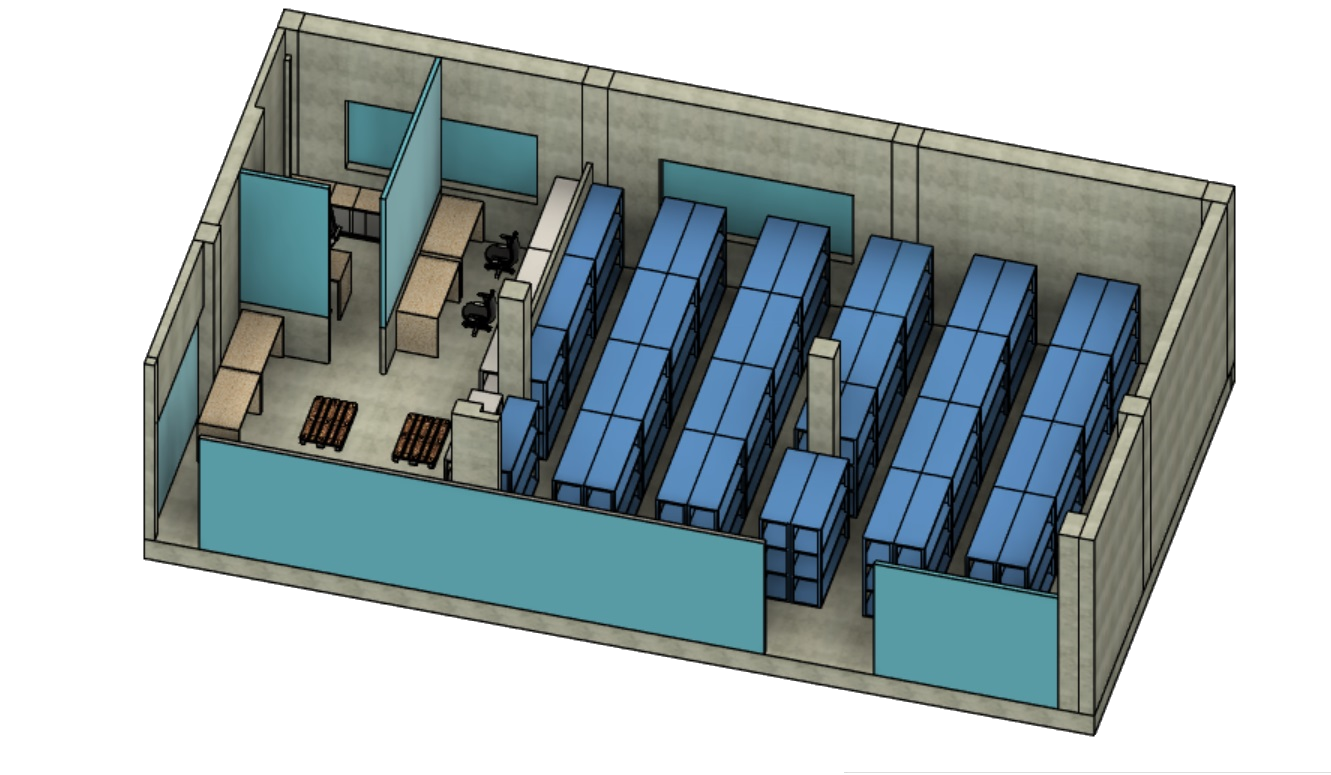
The initial layout, as seen here, combines a proto-warehouse with an all-round accessible unpacking and packing area as well as a small office space on as tiny a footprint as possible.
Due to the “all-access” layout, every employee would be involved to the workings of the business and gain intimate understanding of his and everyone’s duties, supporting training and understanding.
The effect this had on team building at such an early stage was immense and helped quickly find suitable people.
While the products stored in the warehouse were comparatively light with a large percentage of packaging, the storage racks used were of much more robust construction, so calculated as an integral part of the future expansion path while being still investor-acceptable
Energy conservation was also important and could be marketed as environment protectionalism.
In order to facilitate warehousing, each aisle was equipped with motion sensors in order to only illuminate the exact area of operation. This would cut down on energy cost and provide workers with worry-free access.
Since commercial sensors had to be used, Sebastian designed and produced special angled sensor shades that limit the sensor area to the precise area required.
It was a quick and easy solution in line with budget.
Furthermore, this helped us in winning our first award certificate in the field of Green Operation – certificates being very important in China, this helped the company’s reputation.
In Stage 1, lighting and sensors alike would be mounted on inexpensive, disposable metal profiles stuck into the storage rack beams.
Not only does this create a fully functioning and highly cost-efficient business, it also permits all this in an incredibly short amount of time, lower the initial threshold and provide easy scalability.
Critically, daily operations could not be interrupted in any way to ensure supply to demanding customers.
In his planning, Sebastian had already accounted for these points.
Meanwhile, the Covid-19 was worsening and a lockdown loomed, increasing materiel supply tensions and schedules.
One of the reasons Sebastian had chosen that property was the high ceiling.
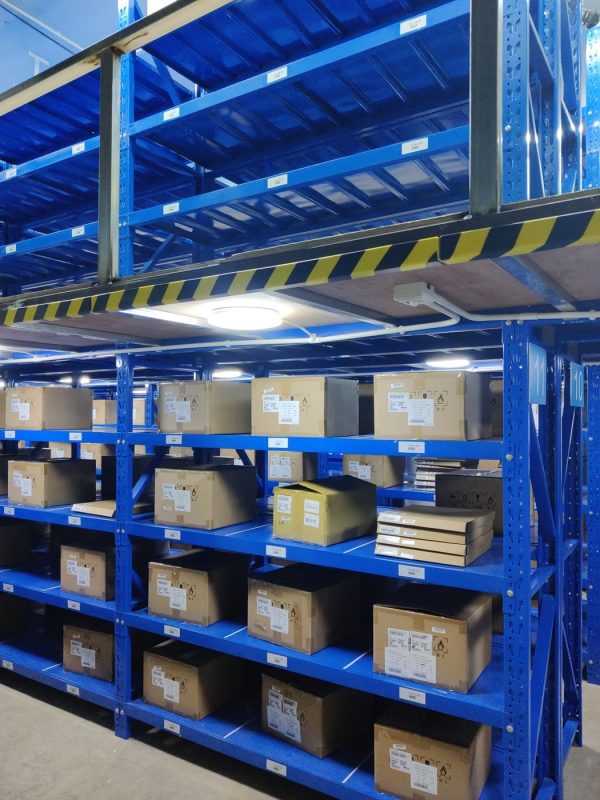
As modifications to the building’s structure were not allowed, we had devised a modular solution relying on racks which, when fully stocked, were far below their maximum weight carrying capacity. As well as a comparatively large floor load capacity of the building.
After working together with and gaining approval by building management, Sebastian designed a set of brackets and braces as well as a modular second-story floor that fit on top of the existing racks.
With all components pre-produced offsite to reduce dirt on all stored goods, reduce interference and increase upgrade speed and efficiency, the modular structure was simply assembled on top of the racks which then acted as a robust and secure foundation for the second story racks.
A freight elevator was installed, the sliding door and mechanism a custom design by Sebastian in order to meet cost requirements. In effect, this noninvasively added a new storey which is not integral to the building and can be easily disassembled and reassembled at a new location for cost efficiency.
Employee access happened via the elevated office, with one staff usually assigned the top warehouse floor, and another on the lower floor working as a team, their handshake point being the elevator shaft.
In practice this worked so well that during stocking or shipping, the goods flow was very quick and smooth with zero wait.
Hinged railings were also incorporated that could be swiveled to allow forklift access or others. This served both as redundancy and in case of special loads.
Each level featured three-zone moisture level control as well as redundant air driers and, as backup, aircon.
On the first level, clever spacing allowed the gaps to be utilized as pallet storage.
Additional challenges due to the Covid-19 situation and fast approaching lockdown were:
a)increased goods demand
b)difficulty in sourcing building materials
c)external contractor contact being a risk a risk simultaneously
d)constantly changing rules and precautions requiring extra capacity
This was another critical moment. Good crisis management would be the best proof of competence in a high-competition, highly troubled market.
The upgrade was projected by Sebastian to take 8 weeks under normal conditions.
As per investor timetable he was granted 6 weeks in spite of the coming lockdown.
He managed to open the double-capacity warehouse within 4 weeks.
It can’t be understated how critical it was to have the right employees, with the right training and understanding of the task and the importance of their efforts.
Space for Server hardware was included and even gaps between weight bearing components was purposefully used as pallet storage. Almost no centimeter remained unused in this extremely compact and efficient solution.
Customers and vendors alike generally commented at never having seen such a degree of efficiency and space usage, providing another success story for the business.
In an extremely competitive sector where a German company has little hope of competing on a price-point, and in the most expensive city of that country, Sebastian had found a way to absolutely beat possibilities.
The prerequisite for Warehouse II was significantly different from and far outside any previous scope or agreement.
Strict orders to acquire much more space but strictly not granted any budget to do so required Sebastian to adjust the strategy to meet demands.
The building complex proved suitably dry and easy to access with only minor modifications and the design of a special, mobile loading/unloading ramp.
Intagration into the IT infrastructure also had to be taken care of.
Carefully balancing the expense in cost, time, effort and trying to preserve the company image, a use for this space then had to be found.
The solution was fourfold:
- Restructuring of company workflow.
Shipments would first be arrive in one section of WH-II, inspected and stored by pallet.
WH-II would, once a week, replenish WH-I which itself was to retain ~4 weeks of goods in individual packages.
WH-I would handle commissioning, the prepared pallets would then be transported to the outgoing area of WH-II for pickup. - Flexible storage locations
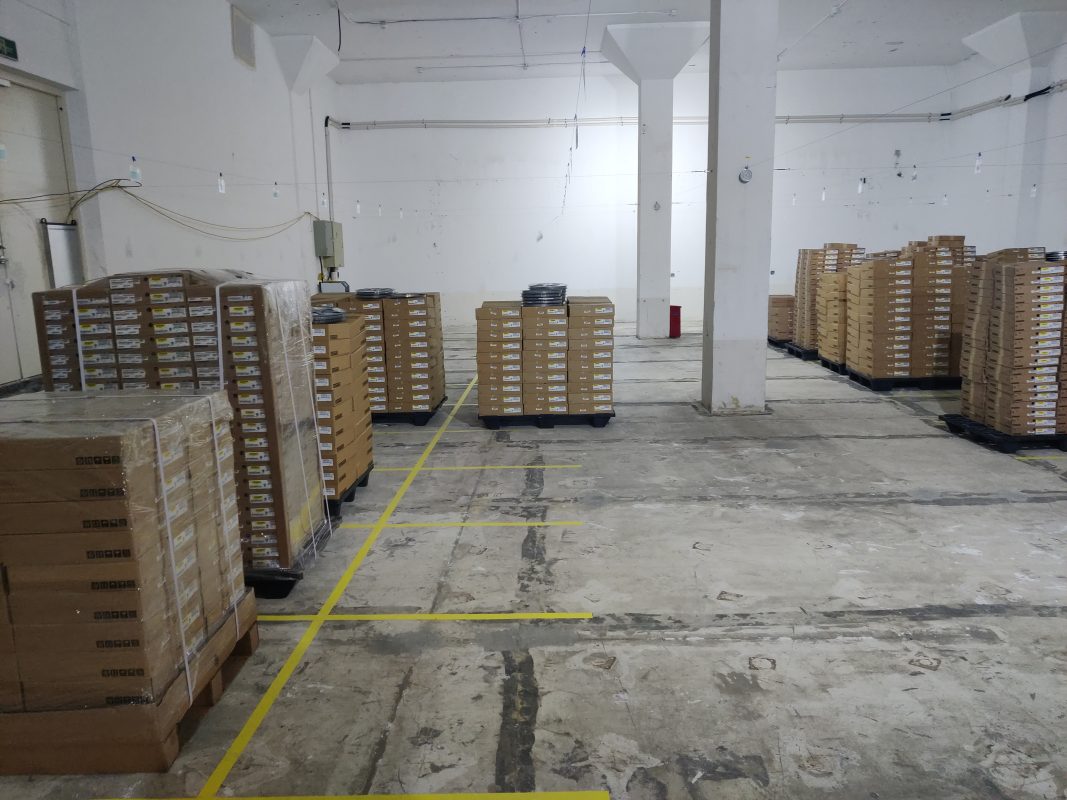
Using a clever system of spaced-out ground markers, generous pallet parking spots were designated.
Scannable tags were hung from movable steel wires attached to walls and pillars.
This extremely cost efficient and versatile system would ensure the required structure, traceability and order.
To store more goods or subdivide entire sections, the wires, tags and markers could be moved to a more efficient spacing within minutes. - Low investment
Forfeiting the use of pallet racks meant savings thereof as well as eliminating the need for powered forklifts.
Should it become necessary in the future, these could always be quickly added by shifting the a/m storage system to one side and upgrading the warehouse in sections. - Commission-renting
The storage solution devised by Sebastian was the most cost-efficient warehouse near the center of the city.
Due to his growing reputation for trustworthyness and efficient solutions, small businesses forced to store their goods out in the countryside showed interest in the competitive rates and logistical benefits.
Corporate operations, in the case of the distribution company in question, required a level of goods scheduling, tracing and planning that can be considered to be at a rather high level of efficiency and accuracy.
Most of the key strenght involved therein lay in the IT infrastructure and thus, this part required a great degree of attention.
Peripherals had to be tightly integrated into the system.
Furthermore, the investor greatly valued data security while requiring a system completely open to his own remote access.
After a comprehensive and detailed analysis of the unique rules and regulations within the PRC in that regard, Sebastian presented crucial points, challenges and needs for adjustment as well as optimized solutions to improve the opportunity-risk situation.
We also highlighted the need to adapt and rethink parts of this solution in order to meet system stability and availability requirements.
As these changes required careful planning and information gathering, we highlighted that they should be worked on fairly early so as not to endager rollout and reaching of operability.
When it became clear that this decision was to be made much too late, Sebastian prepared an interim solution in order to ensure operability and cash flow to bridge the delay between decision and delivery.
As a result, we already had a solution prepared when its necessity was understood.
Close cooperation with the investor’s IT department and external software specialists enabled Sebastian to devise the solution of a stand-alone server programmed and set up by a provider according to German standards.
There would be a permanent remote connection in order to allow the required transparency and control meeting investor requirements.
This was another crucial situation in which the venture could have been doomed by a lack of understanding.
Unfortunately, supply shortages due to the pandemic would cause a 9-month delay.
This was a crucial point which, could doom the endeavor.
The 4-month lead we managed to create through incredible effort got delayed by 9 months, as a result the project moved back by 5 months again.
After gravely underestimating the challenges of implementing a sophisticated supply chain system in the People’s Republic of China, scrambling for a solution would cause unacceptable delays in operability and cash flow.
We had already worked with IT professionals on both continents to provide a starting point for a solution and could thus save some time in planning and implementation.
However, this was insufficient to cover a 9-month delay.
Thus, Sebastian used his IT expertise to establish a simple, reliable and safe interim data storage, order processing and goods tracing system.
While in many points unable to match the final system, it allowed a few very crucial activities:
- Financial compliance
- Basic process establishment
- Training of staff in basic required processes
- Goods and cash flow on a smaller scale
- Supporting activities to supply chain setup
We would provide our employees with our own and donated hardware, assuring smoother transition to the final corporate solution as well as complete data integration once the server became available.
This action saved a couple of months in making the business operational and significantly contributed not only financially but in terms of training, customer and vendor acceptance and more.
The interim solution prepared in advance by Sebastian would be able to handle the ramp-up goods flow until the final system was on-line.
It assured the company had initial turnover, absolutely crucial for the business’s survival in light of the previous oversight.
More crucially, this still allowed process implementation and staff training in order to familiarize the team with operating principles, learn about the industry, commence cooperation with vendors and customers.
To save time in transit, the hardware would be partially prepared, to be finished on-site, the software suite virtually setup and later transferred.
A part of this software suite would still have to be implemented together with the system integrator via remote.
As the implementation coincided with a system upgrade at headquarters, it had not been possible to train on the new system beforehand.
In effect, both locations ended up implementing the system at the same time, learning from each other, speeding up fixes and feature implementation due to parallel troubleshooting.
In this way, the new China branch was able to have a positive effect on the implementation of the system at HQ.
We also used this opportunity to create a strong connection between inter-group teams to strenghten cooperation for the coming order volume transfers and to instill corporate goals and identity.
Core system functionality was established within 4 weeks of hardware reception.
Sliding project management from Sebastian meant that, after this time, standard orders could be processed and the initial guaranteed business case revenue volume handled at this point.
A 4-month lead that had turned into a 5 month delay had been rescued again, the business was back on track with only a 1,5 week delay.
This concluded most of the actual work package initially agreed.
Further systematic implementations, adjustments and fixes would hae to be done in the following months.
After critical items were secured, auxiliary processes, rare cases and improved workflows would be gradually implemented until all business activities could be comprehensively represented in the mandated system.
Unexpectedly to the investor, the sudden need to rapidly establish a new supply chain through a Free Trade Zone had become necessary.
Initially this would be handled via a third party logistics provider.
We refused to represent the investor in this.
However, with our deep process knowledge and short travel distance, we presented the investor with a solution to manage this endeavor remotely.
Working closely together with the 3PL, we collected comprehensive information on the workings of the on-site logistics and IT system as well as defining possible interfaces and routines.
After collecting our findings, we presented those as well as a detailed action plan on how to seamlessly integrate both HQ’s and the 3PL systems in order to provide the customer with an identical level of service within the required time.
Implementing this plan would mean that our investor would fulfil his short-term goals and have hatcha long-term, permanent strategy.
In order to meet financial as well as ideological goals, Sebastian was required to draft a personnel structure that relied on low headcount and strong multirole workflow that went past providing redundancy and reached into operative necessity.
Based on investor self-assessments, they had not done a diligent enough screening of on-site representatives in the past for tangible cultural reasons.
As the initial plan provided a high long-term risk for stability and corporate secrecy with a lack of action plans for likely outcomes, we prepared a solution.
Sebastian drafted plans on optimized structures, remotely preparing a support network as well as talent scouting ahead of time.
As a result, when the investor made the decision to cut ties with previous partners and agents, we already had essential staff ready to support the undertaking.
We designed our personnel strategy on the following framework provided by investor and local situation:
- low funding
- multirole positions
- high reliance on technology
- high efficiency
- quick growth
Many of these were at odds with on-site situation, understanding and possibilities.
Reliance on few workers reduced redundancy, partially offset by remote system operability.
Initially planned, crucial temporary support of HQ staff to help out, i.e. during shortages, were not possible during the Pandemic and increased risk further.
With an abundance of well-established corporations in growing industries all around Shanghai, it would be extremely tough to hire and retain personnel by means of financial compensation and worksite conditions.
As a solution, Sebastian made sure to instill a sense of German operational principles and offering staff nonfinancial benefits.
On a labor market defined by rapid turnover, low stability and limited career development we would provide motivated staff with stability, long-term employment and a career development that had realistic chances of team lead or middle management positions relatively quickly.
As an employer, we would train each staff according to a wide variety of requirements providing redundancy and developing particular personal specializations in accordance with the individual’s desires and capabilities.
At the first stage, this served to create what we call a Key Team that would be able to run the operative business on the initially agreed stage.
While extremely time-consuming to build, train and develop, this Key Team provided the crucial foundation for the startup phase and in establishing well-running processes.
English language skills would mean that, as future team leaders, the rerquirements of said teams would be more easily matched to budgetary constraints.
When the business was expanding, this team would be instrumental in exponential growth due to their high level of training and transferable skill.
The Key Team‘s ability furthermore presented an internal KPI for us to decide when our obligations were completed satisfactorily.
Required members for this scenario:
- Operations specialist (order processing, delivery planning, invoice forwarding)
- Warehouse manager (Physical goods management)
- Sales Engineer (Contact with customer and vendor engineers)
- Sales Rep (Sales and Marketing, representation and networking)